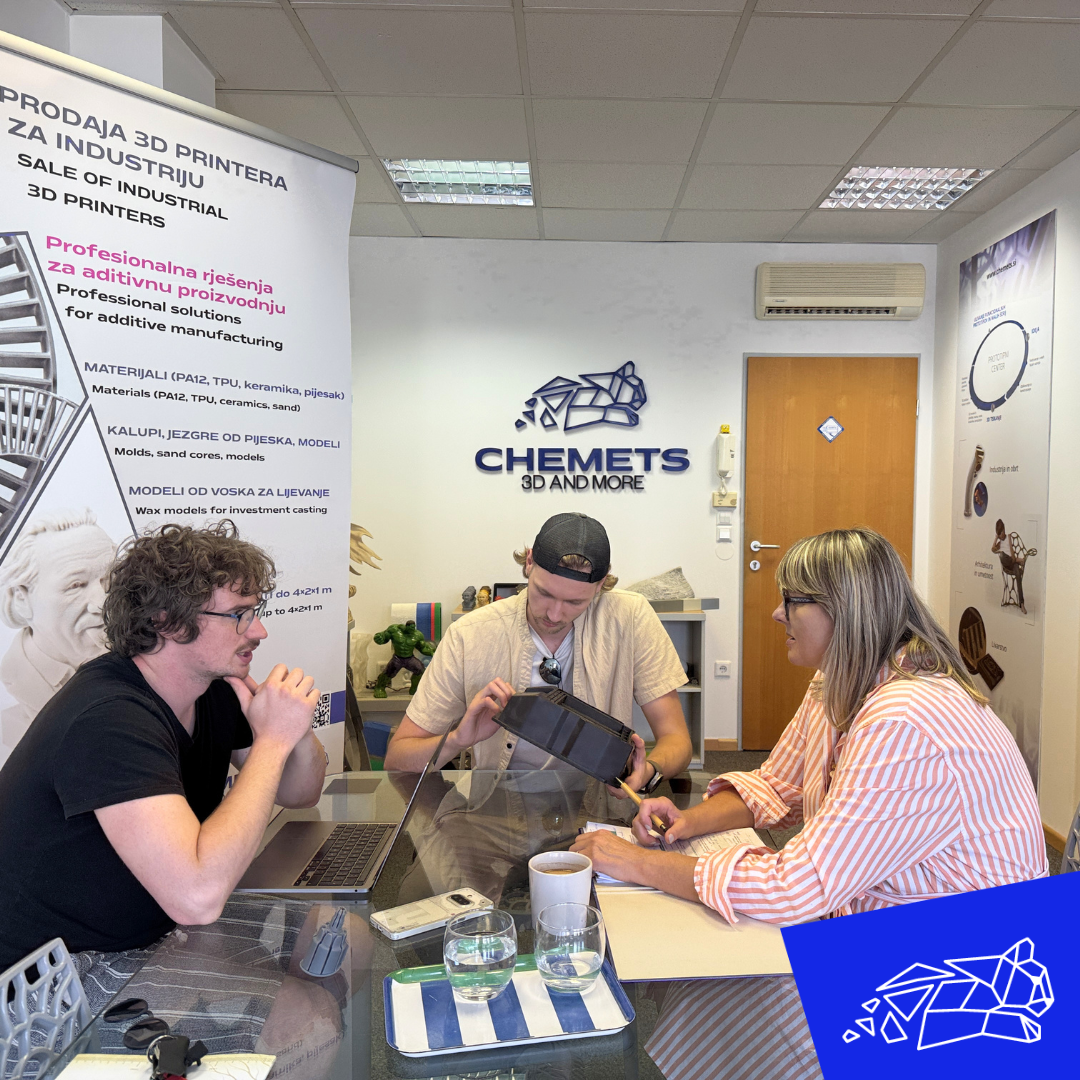
The most expensive investments are not those that turn out to be wrong. They are the ones that convince a company it has modernised, when in reality almost nothing has changed.
A million euros for a new machine. Six months of supplier evaluation. Trade fair visits, ROI calculations and promises of higher productivity. A year later, surprisingly little has changed on the shop floor.
The machine runs faster. People work the same way. The process engineer still
prepares production manually. The operator waits for the program. Quality control still catches defects only at the end of the process. Production still depends on the experience of a few key individuals — when one of them is off sick or leaves, delays follow.
The investment was technically successful. The return on it considerably less so.
The greatest risk when buying new technology is not a poor machine. It is an excellent machine for a process that needed to change. Instead of eliminating bottlenecks, new equipment often just moves them. Instead of automating decision-making, it automates a single operation. Instead of reducing dependence on individuals, the company becomes dependent on those who know how to operate the new equipment.
The right question before any such investment is not whether to buy a new 3D printer. It is: will this investment create a new process, or will you simply run the old one faster?
A new machine inside an old process does not reduce dependence on experienced individuals — it just moves that dependence onto newer equipment.
What a leap forward looks like, versus an upgrade
When a company invests in a 3D printer, it typically expects faster production. The real advantage of additive technologies lies elsewhere: they make it possible to redesign the production process from the ground up.
The simplest example is replacing manually produced tooling with 3D-printed models. Development time shortens, smaller series become economically viable, and the process itself stays broadly the same. That is an upgrade.
A leap happens when the company starts asking different questions. Does it still make sense to cast this part at all? Could certain components be produced directly using metal 3D printing? Can the geometry be adapted to make the part lighter, stronger, and requiring less post-processing? Can several sub-assemblies be merged into a single piece, reducing the number of operations and the potential for errors?
The same logic applies to build preparation. In many companies this is still a manual task: the process engineer arranges models, finds the optimal orientation, estimates distortions and tries to make the best use of the printer's build volume. Most standard software cannot do this automatically — it cannot fill empty space with smaller models, optimise placement based on geometry, or draw on the data from previous builds.
When specialised algorithms or AI agents take over build preparation, the system itself proposes the optimal arrangement, fills unused space, shortens preparation time and reduces the risk of errors before printing begins.
The difference between an upgrade and a leap is not how much faster the printer produces a part. It is how many decisions still need to be made by a person after the investment.
The measure of a leap forward is not print speed — it is the number of decisions the system takes instead of the engineer.
Where companies most often make the wrong decision
Most production investments are not wrong. What is often wrong is the question they are trying to answer. Companies ask which 3D printer to buy, instead of whether 3D printing is the right solution for their product at all. They ask how to speed up production preparation, instead of why preparation requires so much manual work in the first place. Or how to increase capacity, instead of what is actually limiting production today — the machine or the way of working.
This is not the result of poor management decisions. Manufacturing companies are under daily pressure from deadlines, quality requirements and costs. Buying new equipment is a less risky decision than changing a process, because it does not require significant organisational change. In the long run, however, the greatest competitive advantages are not built by companies with the newest machines, but by those that recognise in time which part of their process no longer adds value.
Before any major investment, it is worth setting aside the equipment catalogues and asking a few direct questions: Are we buying a new machine because we have analysed the whole process, or because the competition is doing it? Are we solving the root cause of the problem or only its symptoms? Will we still need the same number of manual decisions after the investment as we do today? Is there a technology that could eliminate certain production steps entirely?
The answers often show that the greatest opportunity is not in a faster machine, but in a different way of thinking about production.
Companies that buy the wrong equipment are rare. More often they buy the right equipment for the wrong problem.

How to approach the decision
At Chemets we have been working with additive technologies since 2006. Over that time we have developed an understanding that cannot be purchased alongside a printer: how additive technologies integrate into the full production process, and where they actually create value.
Some companies need a reliable partner for prototypes, functional parts or series production. Others are looking for more: someone who can help them assess whether their current production approach is still the best choice, which technology to use, which steps to automate, and how to use AI agents to optimise build preparation and capacity utilisation.
Sometimes the right solution is polymer 3D printing. Sometimes metal. Sometimes a combination of casting, CNC machining and additive manufacturing. In some cases the best decision is to keep certain production phases with an external specialist, while the company focuses its energy on product development and higher added-value activities.
If you are considering a production investment and are not sure whether you are solving the right problem, get in touch. We start the conversation with the process, not the printer.