Trends 2026: A new direction for 3D printing – advanced molds, hybrid processes and expansion into new materials.
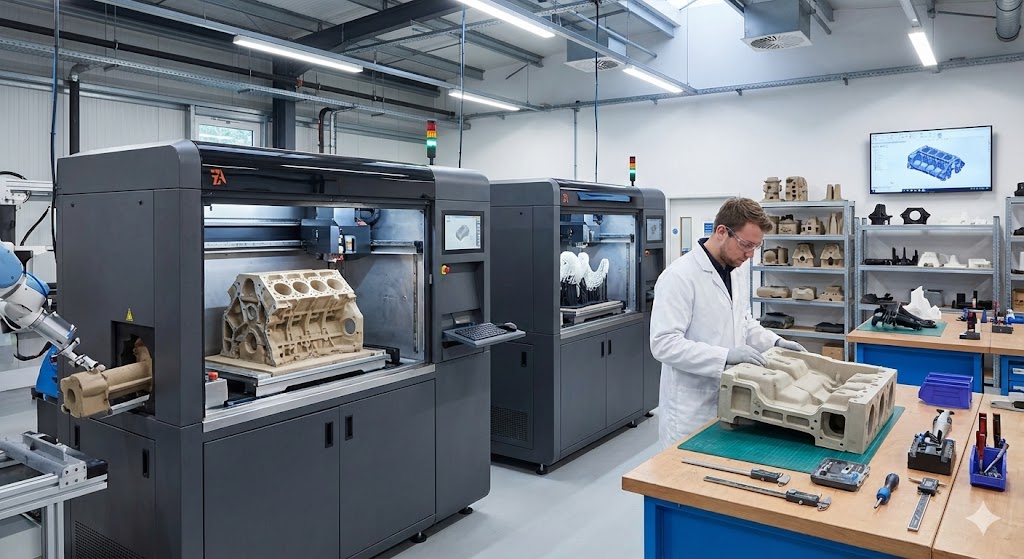
Looking toward 2026, one thing is clear: the greatest development potential lies in the production of molds, cores and models with 3D printing, no longer only for plastics or metals.
There is a strong shift toward:
molds and models for metal casting,
core production,
molds for ceramics,
molds for concrete,
models and molds for glass,
and rapid toolmaking for composites.
This is a segment that is barely open in Slovenia, but has enormous potential.
Why is this the future?
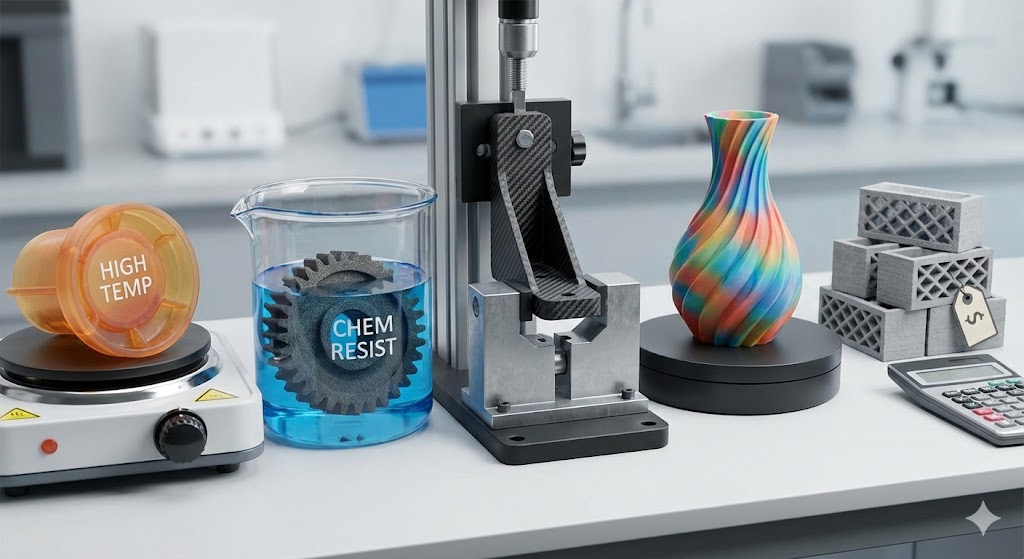
Materials for 3D printing today are:
temperature-stable,
chemically resistant,
mechanically reinforced,
surface-customizable,
and cost-effective.
This enables:
replacement of wooden and PU models,
production of complex molds that cannot be created using conventional processes,
faster product development without expensive toolmaking procedures.
Key development challenges for 2026
New coatings for smoothing and demolding Industry needs coatings with:
higher temperature resistance,
better release properties,
lower friction,
greater stability in repeated use.
Current solutions are limited, which opens a large space for innovation.
2. Impregnations for greater durability of positives (e.g. sculptures, columns, products) For prototype tools, large models or demanding geometries, there will be a need for:
improved impregnation,
greater mechanical stability,
resistance to moisture, temperature and abrasion,
longer service life.
more environmentally friendly materials.
This is an area that industry will inevitably have to upgrade.
Slovenia has an ideal opportunity to become a European leader
Slovenia has all the key elements:
strong toolmaking,
top-level development teams,
a tradition of working with materials,
experience in the automotive and metal-processing industries,
agile, innovative companies.
If we recognize the potential in time and invest in the development of coatings, impregnations and hybrid tools, Slovenia can become one of the leading European centers for industrial use of 3D printing for advanced molds, models and products.
This is a field with little competition and enormous demand for knowledge, which is our greatest opportunity.
Conclusion
3D printing in Slovenia is experiencing its fastest growth so far. Industry understands that it is no longer an experiment, but a strategic tool that shortens development time, reduces costs and enables new solutions that are simply not feasible with traditional methods.
The future belongs to those who will:
understand the technology,
know how to combine it,
and integrate it into broader development–production processes – not only in industry, but also in art, construction, architecture and design.
The year 2026 will be the year when 3D printing crosses traditional boundaries – and Slovenia truly has the opportunity to be among the first to seize this potential. Are we ready?
If you missed it, you are invited to read PART 1: 3D Printing Trends for 2026 – Slovenia.
PART 1: 3D print trends for 2026 – Slovenia
Formnext 2025: Field Notes — Less Flash, More Reality
How We Could Have Saved the Client Over €1,000 – But They Still Chose Otherwise
Collaboration on a Sculpture That Carries a National Award