A personal view after almost two decades of following additive technologies
I have been following additive technologies since 2006 and in that time I have witnessed all the key turning points – from the first enthusiastic beginnings, to rapid technological progress, and the shift into professional and industrial applications. Today, 3D printing is a mature, stable, and proven part of the global industry. In Slovenia, we are at a point where the market is waking up intensively and companies increasingly understand how much of a strategic advantage properly implemented 3D printing can be.
3D printing in Slovenia: from prototype to industrial tool
In recent years, a clear shift has been visible in Slovenia:
3D printing is no longer just a tool for prototypes – it is becoming the standard for:
- functional mechanical parts,
- spare components,
- structurally demanding elements,
- small series without any minimum order quantity,
- rapid tooling and hybrid manufacturing processes.
Growth is gradual but stable. Companies are increasingly recognizing the advantages of fast production, repeatability, lower development costs, and greater flexibility, which is particularly important at a time when:
-
- order quantities are lower,
- lead times are shorter,
- products are more complex,
- documentation requirements are stricter,
- materials are more diverse.
Slovenian industry is ready for broader adoption, but success depends on the correct choice of technology, materials, and a competent partner who understands the entire process.

The Slovenian 3D printing market: who is active and where the limitations are
Today, several types of providers are active on the market:
- Local “garage” operators
– cost-effective FDM solutions, suitable for basic prototypes but not for industrial applications. - Distributors of 3D printers
– they primarily offer what they sell; they lack broader knowledge and technology neutrality. - Specialized providers of individual technologies
– excellent in their niche, but often limited by materials and post-processing options. - Development centers that master several technologies and know hybrid processes
– they enable optimized, individual solutions, not just “printing a file”.
It is precisely this last group that is key today, because industry is not only looking for manufacturing, but for expert consulting and development.

What is really happening in practice – the shift towards industry
The Slovenian market is moving from the “prototype use” phase into the phase of industrial integration. Companies are increasingly looking for:
-
- Functional parts for immediate use
Brackets, housings, connecting elements, process aids, assembly jigs, fixtures …
Parts that go directly into a machine or a final product. - Small-series production
Up to a few hundred pieces, with no minimum order quantity. Ideal for validation, product introduction, or maintenance departments. - Spare parts “on demand”
Production in 24–72 hours – extremely important, as every hour of downtime can cost thousands of euros. - Hybrid manufacturing of tools and functional parts
The most important trend for 2025–2026.
A combination of:- 3D printing,
- CNC machining of critical surfaces,
- metal inserts,
- vacuum casting or sand casting,
- prototype tools.
- Functional parts for immediate use
- The result?
-
-
- 70% faster tool production,
- a dramatic reduction in development costs,
- the possibility to test more iterations without expensive toolmaking interventions,
-
- less waste and more flexibility.
Digital libraries of spare parts
Companies are already digitalizing components and introducing “print-on-demand” systems, which reduces inventory and storage costs.
Why do companies still run into problems?
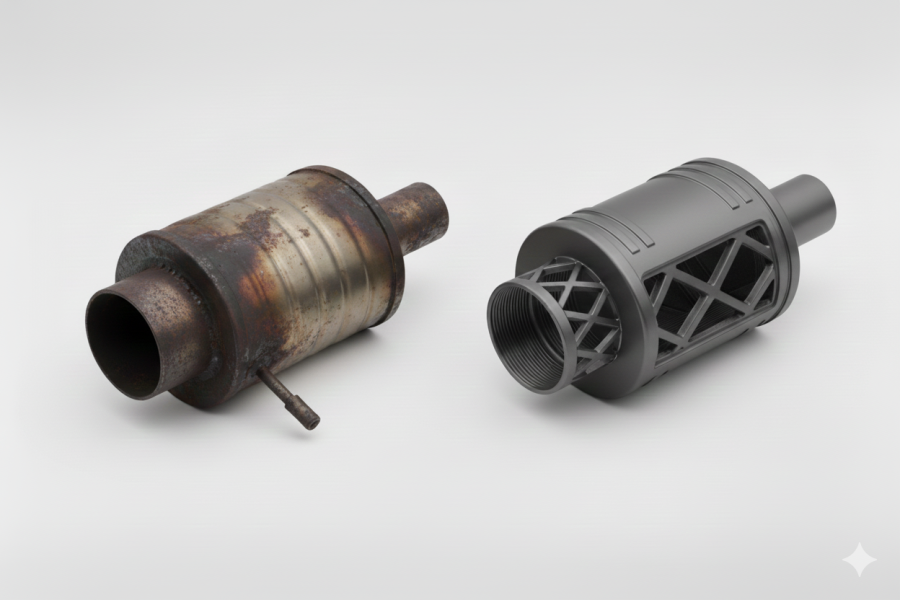
Despite the evident development, Slovenia is still facing challenges that sometimes limit the optimal use of the technology:
- Lack of comprehensive knowledge
Insufficient understanding of the technologies often leads to the wrong choice of manufacturing process or material. - Fragmented supply and lack of consulting
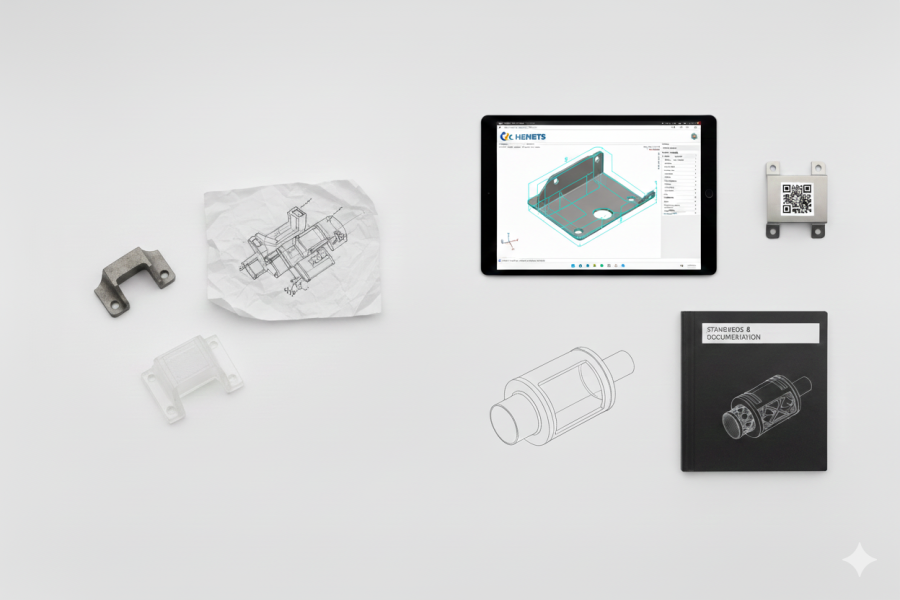
Many companies still only receive a “printed part”, without expert analysis of whether this is really the best solution and without an overview of different manufacturing options. - Need for standardization and documentation
Industry requires measuring protocols, material traceability, certificates, and quality control.
Lack of understanding of hybrid approaches
Many companies still believe they must choose “either CNC or 3D printing”, instead of understanding that the winning combination is both.
Case from practice: the value of a technology-neutral partner
At Chemets 3D & More, where we have been operating as a technology-neutral development center since 2006, we have demonstrated that success depends on:
- knowledge of various additive technologies (SLA, DLP, SLS, MJF, FDM),
- mastery of vacuum casting, CNC, and hybrid approaches,
- understanding of materials and their limitations,
- and support throughout the entire development process.
We do not offer industry a “printed part”, but a solution – from geometry optimization and material selection, to the production of test series or hybrid tools.
You are invited to read Part 2: 3D Printing Trends for 2026 – Global Perspective.